
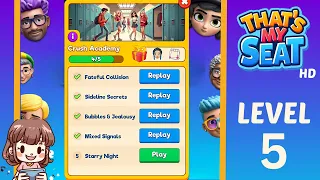
Crush Academy Level 2 Pattern Overview
The Overall Puzzle Structure
At the start of Crush Academy Level 2, players are presented with a basketball court scene, complete with players, lockers, and various items scattered around. The core of the puzzle involves strategically placing characters in specific seating positions to trigger dialogue or events. The level tests the player's ability to observe details in the character descriptions and match them to the available seats, often involving a bit of deduction to figure out who goes where based on social cues or stated preferences.
The Key Elements at a Glance
- Characters: Various students are present, each with unique appearances and potential seating preferences. They are represented by profile pictures at the bottom of the screen.
- Seats: The benches in front of the lockers are the primary interaction points. Each seat can accommodate one character.
- Dialogue/Clues: Text boxes provide descriptions of the characters and their relationships or intentions, serving as hints for correct placement.
- Basketballs: While present in the scene, these are largely decorative and not directly part of the core puzzle mechanic for this level.
- Items: Objects like phones, drinks, and a burger are present on the benches, sometimes associated with specific characters, hinting at their potential seating choices.
Step-by-Step Solution for Crush Academy Level 2
Opening: The Best First Move
The most effective first move is to observe the character descriptions and identify the most straightforward placements. In this level, the clue about "Pinker sits on the left of the trio, headphones on..." is a strong starting point. Looking at the available seating, there's a distinct group of three characters. Placing Pinker on the leftmost seat of that group is a safe bet. This clears up one character's position and provides a foundation for the next steps. The description of "Kuty joined the basketball team tryouts" also suggests Kuty might be near the court or with players, but the seating clues are more direct.
Mid-Game: How the Puzzle Opens Up
After placing Pinker, the next logical step is to examine the remaining characters and clues. The description for Alma, "Alma sits on the trio's right side and doesn't let Nala know that Kuty has been on her mind constantly," is crucial. This tells us Alma is to the right of Nala, and since Pinker is already on the left of the trio, Alma must be on the rightmost seat of that group. This leaves Nala in the middle.
The game then introduces more characters and more complex scenarios. For instance, the clue "Arden couldn't score today, and now he's gulping down an energy drink, looking drained" points to Arden needing a seat where he can relax. The presence of an energy drink on a bench could be a hint. Similarly, "Attley keeps stealing glances at the girls, hoping Pinker will join him for dinner" suggests Attley is interested in Pinker, so placing him near her could be a good strategy. The dialogue also reveals relationships like "Malcolm is also coaching the team," which might place him in a more authoritative or observant position.
As characters are placed, new dialogue options or character emotions might appear, like a character giving a thumbs-up or a heart emoji, confirming a correct placement or providing further clues. The key is to continually cross-reference the character descriptions with the available seats and the visual cues on the benches.
End-Game: Final Cleanup and Completion
The final stages often involve placing the remaining characters based on more subtle hints or by process of elimination. For example, if a character is described as being in a "quiet corner" or away from the main action, look for the seats that fit this description. The clue about "Eeden signed up for the dance team to spend more time with Malcolm and chose a quiet corner" is a good example. Eeden's desire for a quiet corner might mean placing her at the end of a bench or away from a cluster of more boisterous characters.
The game might present opportunities to make choices that affect character relationships. For instance, if Attley is eyeing Pinker, choosing to place them near each other might trigger a positive reaction, or correctly identifying a character's role (like coach or cheerleader) can help place them in the appropriate "seat" of attention. The goal is to fill all the seats correctly based on the narrative clues, leading to a "Well Done!" screen and progression to the next level.
Why Crush Academy Level 2 Feels So Tricky
Misinterpreting "The Trio"
- Why players misread it: The term "trio" might lead players to focus solely on the three characters initially visible in the main basketball scene. However, the seating arrangement often involves more characters on the benches. Players might try to fit the "trio" clue into a group of three on the benches, ignoring other characters or the broader context.
- What visual detail solves it: The solution lies in recognizing that the "trio" refers to a specific grouping of three characters within the larger set of people seated on the benches. The initial descriptions often highlight this group, and subsequent clues will place characters relative to them. The key is to look at the entire row of benches.
- How to avoid the mistake: Pay close attention to the descriptions of characters interacting with each other. If a clue mentions someone being "to the left/right of the trio," identify the three characters that are most closely grouped together on the benches, rather than assuming it refers to characters in the background scene.
The Subtle Hint of Items
- Why players misread it: The items on the benches (drinks, phones, burgers) can seem like mere decoration. Players might focus only on the character descriptions and overlook these objects as potential clues.
- What visual detail solves it: The video shows that specific items are associated with certain characters or actions. For example, Arden is described as drinking an energy drink, and there is an energy drink on one of the benches. Similarly, a burger is present, which might be linked to a character mentioned eating. These items act as direct visual anchors for character placement.
- How to avoid the mistake: Always scan the entire scene, including the items on the benches, after reading a character's description. If a character is described as consuming or holding something, look for that item on the available seats. This often provides a definitive placement clue.
Relationship Dynamics and Gaze Direction
- Why players misread it: The hints about character relationships, like Attley "stealing glances" or someone being on another's "mind," can be abstract. Players might struggle to translate these social cues into physical positions on the benches.
- What visual detail solves it: Observe the direction characters are facing or their expressed emotions (like hearts or thoughtful expressions). Attley's glances toward Pinker suggest they should be seated in a way that allows for this visual interaction, perhaps on adjacent seats or with a clear line of sight. Kuty being "on someone's mind" might mean that character should be placed in a position where they would naturally notice or be noticed by Kuty.
- How to avoid the mistake: When a clue mentions interaction or interest between characters, try to arrange them on the benches so that the described dynamic makes visual sense. If Attley is looking at Pinker, they should ideally be positioned so that this is possible, rather than being on opposite ends of the court or facing away from each other.
The Logic Behind This Crush Academy Level 2 Solution
From the Biggest Clue to the Smallest Detail
The most effective strategy for clearing Crush Academy Level 2 involves a top-down approach, starting with the most explicit clues and then using more subtle details to fill in the gaps. The game is designed to provide a sequence of deductions.
- Identify Explicit Clues: Look for descriptions that directly state a character's position relative to another or a specific object. For example, "X sits to the left of Y" or "Z is sitting by the [item]." These are your anchors.
- Place Anchor Characters: Place the characters with the most direct clues first. This locks in key positions and simplifies the puzzle board.
- Deduce Relative Placements: Once anchor characters are placed, use clues that describe relationships or relative positions to place other characters. For instance, if you know where character A is, and character B is "next to A," you can deduce B's position.
- Utilize Item Clues: If a character is associated with an item, and that item is visible on a seat, this is a strong indicator of where that character should go.
- Consider Gaze and Interaction: For more complex relationships, use visual cues like character direction or emojis to infer who should be near whom.
- Process of Elimination: For any remaining characters or seats, use the process of elimination based on the clues you've already solved. If only one character and one seat are left, and the description fits, place them there.
The Reusable Rule for Similar Levels
The core logic of this level – starting with definitive clues and layering deductions – is a fundamental puzzle-solving technique applicable to many similar "seating" or "ordering" style puzzles in games.
- Prioritize Direct Information: Always start with clues that give concrete information (e.g., "first," "left," "beside," "on the table").
- Build a Chain of Logic: Each correctly placed character or solved clue should inform the placement of others. Think of it like a domino effect, where one piece falling triggers the next.
- Cross-Reference Everything: Don't rely on a single clue. Check if your placements are consistent with all other available information, including visual details and character interactions.
- Look for Environmental Hints: Items, object positions, and character orientations are often more than just background. They are designed to be part of the puzzle's information set.
- Embrace Elimination: When direct clues run out, logical deduction and elimination become your most powerful tools.
FAQ
How do I know which character goes where in Crush Academy Level 2?
Focus on the dialogue clues provided. Look for specific positional information (e.g., "to the left of," "next to") and any mention of items characters are associated with (like a drink or a burger). These details are key to correctly seating everyone.
What if I can't figure out a character's placement?
If a clue is ambiguous, try placing characters with more direct clues first. Use the process of elimination for the remaining characters. Sometimes, a character's interaction or gaze direction with another character can provide the missing hint.
Are the items on the benches important for solving the puzzle?
Yes, the items are often crucial hints. If a character description mentions them holding or consuming something, and that item is visible on a bench, it's a strong indication of where that character should be seated. Always check the items for placement clues.