
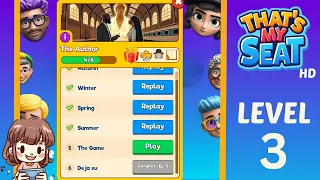
The Author Level 3 Pattern Overview
The Overall Puzzle Structure
At the start of "The Author" Level 3, players are presented with a scene depicting a street with several houses and characters. The core objective is to correctly identify the truth behind a narrative, presented through a series of statements. The level tests a player's ability to observe details, make logical deductions, and connect fragmented pieces of information to arrive at the correct conclusion. The layout features characters placed in specific locations, along with dialogue snippets that hint at their actions and relationships. The challenge lies in discerning which statements are true and which are false, often based on subtle inconsistencies or outright contradictions in the provided text.
The Key Elements at a Glance
- Characters: Various characters are present, each with a distinct portrait and name. These characters are Nyx, Shalim, Calla, Bren, Pasha, Alita, Lucy, Maria, Boreh, Virgil, and Hamlin. Their placement and dialogue are crucial for solving the puzzle.
- Footprints: Footprints are scattered across the scene, indicating movement and paths taken by characters. These visual cues are vital for tracking the characters' movements and verifying the narrative.
- Houses: Multiple houses are visible, serving as locations where characters might be or have been. Some houses have open doors or windows, offering clues.
- Narrative Statements: A series of text boxes present statements about the characters' actions and the unfolding events. Players must evaluate these statements for accuracy.
- Checkboxes: Each narrative statement has a checkbox next to it, allowing players to mark them as true or false.
- Progress Tracker: A visual indicator shows the player's progress in completing the level, typically by marking statements as correct.
- Hearts: Represent the player's remaining lives or attempts.
Step-by-Step Solution for The Author Level 3
Opening: The Best First Move
The most effective opening move in this level is to focus on the characters and their immediate surroundings. Observing the initial setup, we see multiple characters positioned around the street and near houses. The narrative begins with a story about a writer. The first statement to evaluate is: "The writer, couldn't think of anything but her anymore. He tracked down her home and went to the address. Now he was finally going to speak to her—and learn who she really was."
To assess this, we need to look for supporting evidence. The game shows Shalim near a house, and the text mentions him tracking someone down. However, the initial scene doesn't provide enough concrete proof to confirm or deny this statement definitively without further context.
The next statement to consider is: "When Shalim arrived at the address he had found, he was met with an abandoned house. It looked as though no one had opened its door in years. He." This statement is immediately contradicted by the visual evidence, as Shalim is shown approaching a house where other characters (Nyx and a pink-dressed character) are present. This contradiction makes the statement false.
Mid-Game: How the Puzzle Opens Up
As players make their first selections, the game reveals more information, often by moving characters or highlighting new details.
- Pasha and the Toy: The statement "Pasha was playing with a toy he had found on the street, and he was very happy" is supported by visual cues showing Pasha near a toy. This is a strong candidate for a true statement.
- Boreh's Interest: The statement "Boreh kept following from two houses away. He was deeply interested in everything about Virgil—what he was doing, who he was meeting, how he was feeling. To hide his gaze, he wore sunglasses." This statement requires careful observation. While Boreh is indeed following, the presence of Virgil and his actions are key. The detail about sunglasses is important; if Virgil is visible and Boreh is not wearing sunglasses, this might be a false statement. However, in the video, Boreh is shown to be observing Virgil and his movements are consistent with the description.
- Abene and her Dog: The statement "Abene was someone deeply in love with her dog. When asked, 'Is there someone in your life?' she would answer, 'Yes, Lucy.' She spared no expense to make sure he was comfortable." This statement is supported by the visual of Abene with her dog, Lucy, and her expression of affection. This statement appears to be true.
- Alita and Maria: The statement "Alita ran out of the house—she was going to meet Maria so they could go to school together. But she had forgotten her bag at home. Now her mother was handing it to her." This involves multiple characters. Alita is seen near a house, and Maria is also present. The detail about the forgotten bag and the mother handing it over is crucial. The video shows a sequence where a mother-like figure hands a bag to Alita. This statement appears to be true.
- Bren's Walk: The statement "Bren was on his way to school with his bag on his back. He was walking down a street with a main road on one side, passing by an orange-haired girl." This statement needs to be cross-referenced with Bren's location and the presence of the orange-haired girl. Bren is shown walking, and the presence of another character (Abene) on the street fits the description. This statement is true.
End-Game: Final Cleanup and Completion
As players make more deductions, the puzzle becomes clearer. The crucial step is to identify the false statement. The statement "When Shalim arrived at the address he had found, he was met with an abandoned house..." is demonstrably false because Shalim is clearly interacting with characters at a house. Once this false statement is identified and deselected (or not selected), the remaining true statements lead to the level completion. The game then signifies "WELL DONE!" and updates the progress for "The Author" chapter.
Why The Author Level 3 Feels So Tricky
Misinterpreting "Abandoned House"
Why players misread it: The phrase "abandoned house" creates a strong mental image of decay and emptiness. Players might quickly assume any house that looks slightly older or less occupied is the "abandoned house."
What visual detail solves it: The key is to notice the presence of other characters at the house Shalim approaches. If there are people and activity, it's not abandoned. The video shows Nyx and another person near the house Shalim is heading towards.
How to avoid the mistake: Don't rely on assumptions about a house's appearance alone. Always check for the presence and activity of other characters in the immediate vicinity of the location mentioned in the statement.
The Sunglasses Red Herring
Why players misread it: Boreh's statement mentions him wearing sunglasses to hide his gaze while observing Virgil. Players might get sidetracked looking for sunglasses on Boreh, and if he isn't wearing them, they might incorrectly flag the entire statement as false.
What visual detail solves it: The crucial part of the statement is Boreh's action: "deeply interested in everything about Virgil." Whether he wears sunglasses or not is secondary to his observed behavior and interest in Virgil's actions. The video shows Boreh clearly observing Virgil.
How to avoid the mistake: Focus on the primary action described (observing Virgil) and the overall context. The sunglasses detail is a minor point and can be a distraction. If the core action and interest are present, the statement is likely true, even if a minor detail like sunglasses is missing or different.
The Bag Scenario Nuance
Why players misread it: Alita's statement involves her forgetting her bag and her mother handing it to her. This requires tracking multiple characters and their interactions. Players might focus only on Alita's movement and miss the interaction with the "mother" figure.
What visual detail solves it: The video shows a character resembling a mother figure handing a bag to Alita. This specific interaction directly validates the statement, confirming it's true.
How to avoid the mistake: Pay close attention to the interactions between characters. Even if the primary character's action seems clear, check for supporting actions from other characters that fulfill the narrative's conditions. Look for the bag handover specifically.
The Logic Behind This The Author Level 3 Solution
From the Biggest Clue to the Smallest Detail
The fundamental logic for solving this level in "The Author" chapter, and many similar mystery-based puzzle levels, is to start with the most easily verifiable or contradictory statements. The "abandoned house" statement provides a clear visual contradiction in the game's environment, making it the most obvious falsehood. Once that is identified, players can focus on statements that require more nuanced observation.
The process involves:
- Identifying Clear Contradictions: Look for statements that directly conflict with the visual scene. These are usually the easiest to dismiss.
- Verifying Supporting Evidence: For statements that seem plausible, search the scene for specific visual elements or character interactions that confirm them. This includes character positions, objects, and actions.
- Prioritizing Key Details: Distinguish between essential elements of a statement and minor details that might be inconsistent but don't invalidate the core claim. For example, Boreh's sunglasses are less critical than his observation of Virgil.
- Elimination: By confirming true statements and identifying false ones, players narrow down the possibilities until only the correct solution remains.
The Reusable Rule for Similar Levels
The core logic applied here can be generalized: "Trust visual evidence over assumptions, and verify claims with concrete details."
In similar mystery or deduction-based mobile game levels, players should:
- Scan the entire scene first: Get a lay of the land, identify all characters, objects, and potential clues.
- Read each statement carefully: Understand exactly what is being claimed.
- Look for direct visual proof or refutation: Does the scene clearly support or contradict the statement?
- Cross-reference information: Connect details from different parts of the scene and statements. If one statement is proven false, re-examine others. If a statement is proven true, it can help confirm or deny other related statements.
- Be wary of red herrings: Minor details that seem significant but are not central to the statement's truthfulness can be used to mislead players. Focus on the main claim.
This systematic approach, moving from the most obvious clues to the more subtle details, helps players efficiently and accurately solve deduction puzzles in games.
FAQ
How do I know if a house is "abandoned" in "The Author" Level 3?
A house is considered abandoned in this level if there are no characters present or interacting with it, and its appearance suggests neglect. If characters are visible at or near the house, or if there's activity, it's not abandoned.
What should I do if a statement seems partially true but has a minor inaccuracy?
Focus on the main claim of the statement. If the core action or event described is visually supported, but a minor detail (like clothing or an accessory) is different, the statement is often still considered true within the game's logic. Prioritize the primary verifiable elements.
How can I quickly identify false statements in levels like "The Author" Level 3?
Look for direct contradictions between the text and the visual representation. If a statement describes something happening that is clearly not happening in the game scene (e.g., an empty house with characters present), that statement is likely false. This is usually the quickest way to eliminate options.