
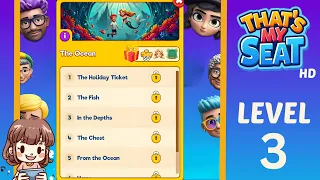
The Ocean Level 3 Pattern Overview
The Overall Puzzle Structure
At the start of The Ocean Level 3, players are presented with a symmetrical seating arrangement. The goal is to correctly seat all characters according to the story's progression. The scene is set underwater, with mermaids and castles suggesting a fairy tale or fantasy theme. The core mechanic involves dragging and dropping character portraits onto designated seats arranged in a specific pattern. The level fundamentally tests the player's ability to follow a narrative sequence and match characters to their narrative positions, rather than a typical matching or puzzle-solving mechanic.
The Key Elements at a Glance
- Characters: Multiple character portraits, each with a unique appearance, need to be placed in specific seating positions.
- Seating Arrangement: The seats are arranged in a symmetrical, almost amphitheater-like layout, with a central pathway.
- Story Progression: The text at the bottom of the screen provides clues to the correct placement of each character. The order in which characters are introduced and described in the narrative is crucial.
- "That's My Seat" Logo: This is the game's branding, present on the UI.
- Hearts: These likely represent lives or attempts available to the player.
- Gems/Coins: These are in-game currency, visible in the top section.
- Timer: A timer is present, indicating a time limit for completing the level.
- Boosters/Power-ups: Options to use boosters are available before starting a level.
Step-by-Step Solution for The Ocean Level 3
Opening: The Best First Move
The most effective opening move is to focus on the characters explicitly mentioned and described first in the narrative. In this level, the story begins by introducing "Maki" and his situation, followed by "Okeke." The first obvious placement is Maki, as his position is the most directly described. He is placed centrally. Then, Okeke's description as being near the king and on his left suggests her placement relative to Maki. This initial placement of Maki and Okeke establishes a central anchor point for the rest of the seating.
Mid-Game: How the Puzzle Opens Up
Following the placement of Maki and Okeke, the game presents more characters and their relationships. Ashur is described next, and his position relative to Okeke needs to be considered. Then, Bitron, Sefu, and Batini are introduced. Each character's description provides clues to their relative positions. For example, if one character is described as being to the left or right of another, or standing between two specific individuals, this information should be used to guide their placement. The symmetrical nature of the seating means that characters often have corresponding positions on opposite sides of the central pathway. The key is to continuously refer back to the narrative text for each character's description and use it to deduce their location. As each character is correctly placed, the remaining open seats become easier to fill based on the remaining characters and the established narrative order.
End-Game: Final Cleanup and Completion
As the end of the level approaches, only a few characters and seats remain. The final characters like Leta, Lorely, Nya, and Pili are introduced, and their descriptions will pinpoint their remaining spots. The last few placements might involve more nuanced positional clues, such as being between two characters already seated or at the end of a row. The challenge here is to ensure no character is misplaced. By systematically working through the narrative and the available seating, the final characters will naturally fall into their correct positions, completing the seating arrangement and clearing the level. The critical step is to verify each placement against the story's context before moving on.
Why The Ocean Level 3 Feels So Tricky
Misinterpreting Relative Positions
Players often struggle with relative positional language like "to the left of" or "between." In the context of the game, this might be misinterpreted if players don't consider the perspective of the characters themselves or the perspective of the viewer looking at the screen. For instance, "to the left of the king" might mean the viewer's left, or the character's left. The solution lies in observing how other characters are placed. When a character is placed correctly, their orientation and the surrounding seats can clarify ambiguous descriptions. For example, if Okeke is placed to the king's left, and then another character is described as being to Okeke's left, the visual confirmation of the already placed characters helps to resolve the spatial relationship.
Assuming a Simple Linear Progression
While the story provides clues, it doesn't always present characters in a strictly linear seating order from left to right or top to bottom. Players might expect a straightforward sequence, but the narrative can jump between characters or describe their positions in a more complex, interconnected way. The trick here is to not just read the descriptions but to actively visualize them. For example, if a character is described as being "near the throne," and another is "standing in front of the guards," players need to mentally map these descriptions onto the visual layout. The key is to understand that the puzzle isn't just about reading, but about interpreting the spatial relationships described within the narrative and applying them to the visual grid.
Overlooking Visual Cues for Character Identity
Sometimes, the most crucial clues are embedded in the character portraits themselves, beyond just their names. Differences in attire, accessories, or even subtle expressions can hint at their roles or relationships. For instance, a character described as a "guard" might have a specific type of armor or weapon depicted in their portrait. Players might overlook these details and focus solely on the text. The solution is to carefully examine each character's visual design. If a description mentions a character's role, look for visual cues that reinforce that role. This can help confirm a placement or even provide a hint when the text is vague.
The Logic Behind This The Ocean Level 3 Solution
From the Biggest Clue to the Smallest Detail
The fundamental logic of this level revolves around sequential narrative interpretation. The most significant clue is the overarching story presented at the bottom of the screen. Each character's introduction and their described interaction or position within that story is the primary driver for their placement. The solution begins by identifying the most definitively placed character – often the protagonist or the character described in the most concrete terms. From there, each subsequent character's position is deduced by their relationship to those already placed, using descriptive text as the guide. It's a process of building a network of relationships, starting from the most anchored point and branching outwards, using the visual layout as a map.
The Reusable Rule for Similar Levels
The core rule for solving these "That's My Seat" narrative placement levels is to prioritize concrete positional information and relative relationships described in the story over vague descriptions or simple visual matching. Always start with the character whose position is most explicitly stated. Then, use that character as a reference point for placing the next, and so on. If a character is described as being "next to," "in front of," or "between" others, this is more critical than a character simply being visually similar to another. Pay close attention to the order of introduction in the narrative, as this often implies a sequence of events or a natural flow of arrangement.
FAQ
How do I know the correct order to place the characters in The Ocean Level 3?
The correct order is determined by the narrative progression described in the text at the bottom of the screen. Read the story carefully, and place characters based on how they are introduced and described in relation to each other.
What if I misplace a character? Can I move them?
Yes, you can typically drag characters to different seats if you realize they are misplaced. However, it's best to try and place them correctly the first time by carefully reading the story clues.
Are there any tricky elements in The Ocean Level 3 that might trip me up?
The level can be tricky if you misinterpret relative positioning (e.g., "left of" meaning the character's left vs. the player's left) or if you assume a linear placement order that doesn't match the narrative flow. Always refer back to the story for context.