
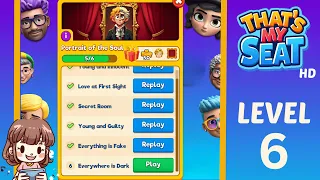
Potrait Of The Soul Level 2 Pattern Overview
The Overall Puzzle Structure
At the start of "Potrait Of The Soul" Level 2, players are presented with a scene depicting a theater audience. The core gameplay revolves around identifying and correctly seating characters based on dialogue snippets and visual cues. The primary mechanic involves matching characters to their described locations or relationships within the theater setting. The board is essentially a grid of seats, with certain seats occupied by characters and others empty. The level is fundamentally testing the player's ability to parse descriptive text and connect it to the visual arrangement of the characters. It's not just about finding a match, but understanding the spatial relationships and context provided.
The Key Elements at a Glance
- Characters: Each character is represented by a profile picture and a name. These are the primary elements to be placed or matched.
- Seats: The theater seats are the primary interactive element. They can be empty or occupied by a character. The arrangement of these seats and the characters within them is crucial.
- Dialogue Snippets: These are the descriptive texts that provide clues about character placement, relationships, or actions. They are the core of the puzzle's logic.
- "That's My Seat" Logo: The game's title logo is prominently displayed, indicating the game being played.
- Hearts/Lives: These represent the player's remaining chances or attempts.
- Lightbulb Icon: This likely represents a hint system, providing assistance if the player is stuck.
- "Well Done!" Screen: This appears upon successful completion of the level, showing progress within the story chapter.
- Portrait Completion Bar: This indicates the progress towards completing the current story segment, showing "Portrait of the Soul 2/6" as observed in the gameplay.
Step-by-Step Solution for Potrait Of The Soul Level 2
Opening: The Best First Move
The most effective first move in this level is to focus on the characters who are explicitly described as being in specific, easily identifiable positions. In this particular playthrough, an excellent starting point would be to identify the character explicitly stated to be in the front row or with a distinct relationship to another character mentioned. For instance, if the dialogue mentions someone "watching from the front row," that character should be a high priority for selection. This simplifies the rest of the level by establishing a clear anchor point. Once a character is placed or identified based on such a definitive clue, it often helps to eliminate other possibilities and narrow down the remaining options.
Mid-Game: How the Puzzle Opens Up
As the player progresses through the dialogue snippets, new characters are introduced, and their relationships or positions become clearer. A key strategy during the mid-game is to look for descriptions that link two or more characters. For example, if the text states, "X was sitting with Y, and Z was behind him," this provides a chain of connections. Players should systematically try to place these interconnected characters. Successfully matching one character often reveals the correct placement for others. If a character is mentioned as being in the "middle row," or "to the left/right" of someone already placed, this information should be used to narrow down the available seats. The goal is to build a network of correctly placed characters, using each solved piece of information to unlock the next.
End-Game: Final Cleanup and Completion
In the final stages, players are often left with a few characters and a limited number of seats. The remaining clues might be more subtle or rely on eliminating the last few possibilities. It's important to review all the dialogue snippets one last time, ensuring no detail was overlooked. Sometimes, a character's description might seem ambiguous until other placements are confirmed, which then clarifies their position. The final tricky steps usually involve placing characters who have the most complex or indirect descriptions. Successfully matching the last few characters, often by process of elimination, leads to the completion of the level. The "Well Done!" screen signifies the successful resolution of the puzzle.
Why Potrait Of The Soul Level 2 Feels So Tricky
Misinterpreting Spatial Relationships
A common trap in this level is misinterpreting descriptions of seating arrangements. Players might read "to the left" or "behind" and assume a direct adjacency without considering the full context of the theater layout. The visual of the rows and aisles is important. For example, someone might be described as being "to the left" of a character, but if that character is on the aisle, the description might mean the next seat over, or it could be interpreted more broadly to mean somewhere in the same row but further down. The solution lies in carefully observing the visual layout of the seats and the characters already placed. If character A is described as being to the left of character B, and both are in the same row, the player should look for the immediately adjacent empty seat on character A's left.
Overlooking Subtle Character Traits
Another tricky aspect can be overlooking subtle visual cues or personality traits that might be hinted at in the dialogue. For instance, a character might be described as "a man of wisdom" or someone "watching intently." While the primary focus is on seating, sometimes these descriptive elements can indirectly confirm a placement if other characters are also described with complementary traits or occupations that fit the scene. The key here is to realize that while the game is about seating, the dialogue is richer than just directional instructions. Players should pay attention to the character portraits and their attire, as these can sometimes offer thematic hints that align with the dialogue, helping to confirm a correct placement when other clues are scarce.
The Danger of Assumptions Based on Common Tropes
Players might fall into the trap of making assumptions based on common theater-going tropes. For instance, assuming the "city's chief of police" would automatically be in a prominent seat, or that a "painter" would be at the very front. The puzzle intentionally subverts these expectations. The solution relies on the explicit textual clues, not on preconceived notions about character roles. The visual detail that solves this is the text itself. When a clue states "Silas was the city's chief of police. He was sitting with Jack and Felix," the player must prioritize the direct statement of his companions over any assumptions about his seating preference. Trusting the text precisely as written, rather than inferring based on stereotypes, is the way to avoid this pitfall.
The Logic Behind This Potrait Of The Soul Level 2 Solution
From the Biggest Clue to the Smallest Detail
The overarching logic for solving this level, and many like it, is to prioritize the most definitive clues first. These are typically statements that explicitly link characters to specific locations or to each other. For example, a statement like "X was in the front row" or "Y sat next to Z" provides concrete placement information. Once these "big clues" are used to place characters, the player can then use the more nuanced or relational clues (like "A was behind B" or "C was in the same row") to fill in the remaining seats. This process of starting with the most constraining information and working towards the less restrictive pieces allows for a systematic and efficient solution. It's about deconstructing the problem by identifying the most solid pieces of the puzzle and building outwards.
The Reusable Rule for Similar Levels
The reusable rule for similar levels in "That's My Seat" and other logic-based puzzle games is to always identify and act upon the most direct and unambiguous pieces of information first. This means:
- Prioritize positional statements: Look for clues that specify exact rows, seats, or immediate neighbors.
- Use relational clues to confirm: Once some characters are placed, use clues that describe relationships between characters ("next to," "behind," "in front of") to deduce the positions of others.
- Eliminate possibilities: As characters are placed, remove them from the list of unassigned characters and mark their seats as occupied. This process of elimination is crucial for narrowing down the remaining options.
- Cross-reference: If a character seems to fit multiple potential spots, re-read all clues related to them and their neighbors to ensure the placement is consistent with all available information.
This strategy of working from certainty to deduction is a fundamental problem-solving approach applicable to many puzzle types beyond just this game.
FAQ
How do I know which character is which in "Potrait Of The Soul" Level 2?
You can identify characters by their unique profile pictures and names. When dialogue snippets mention specific names, cross-reference them with the character portraits at the bottom of the screen to ensure you're matching the right person to the right clue.
What if I can't find a character's exact seat?
If a character's seat isn't explicitly stated, look for clues that describe their relationship to other characters who are placed. For example, if you know where person A is, and the clue says person B is "to the left" of A, you can deduce person B's seat. Use the process of elimination for any remaining characters.
Are there any characters that can be placed anywhere initially?
No, for this level, it's best to avoid placing characters randomly. Every character has a specific place based on the dialogue. Start with the most definitive clues, such as those mentioning specific rows or direct adjacency, to establish a solid foundation before moving to more ambiguous descriptions.