
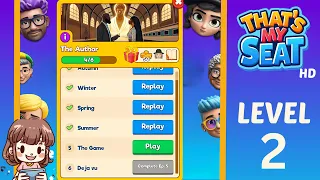
The Author Level 2 Pattern Overview
The Overall Puzzle Structure
At the start of Level 2 in "The Author" chapter, you're presented with a scene resembling a hallway or a pathway. Several characters are positioned along this path, each associated with a specific item or clue. The primary objective appears to be identifying the correct sequence of characters or actions based on the narrative clues provided. The board itself features distinct sections where characters can be placed or moved, suggesting a logic puzzle where spatial arrangement and character interactions are key. The level is fundamentally testing your ability to decipher the story's narrative and connect characters to their actions or locations within the scene.
The Key Elements at a Glance
- Characters: The core elements are the various character icons, each representing a person involved in the story. These characters are to be placed in specific slots or positions.
- Footprint Tiles: These are the primary interactive elements. They represent steps or locations on the path, and characters must be moved onto them. The goal is to correctly match characters to these tiles based on the narrative.
- Items: Various items are scattered throughout the scene, such as coffee cups, donuts, and books. These items are often associated with specific characters or events, serving as clues.
- Narrative Clues: Text boxes provide the story's dialogue and descriptions, which are crucial for deducing the correct placement of characters.
Step-by-Step Solution for The Author Level 2
Opening: The Best First Move
The most effective first move observed is to place Ebrar onto the first available footprint tile in the lower section of the screen. This action is strategic because the narrative immediately after this placement clarifies Ebrar's interaction and proximity to another character. By starting with Ebrar, you begin to anchor a sequence that can be built upon with subsequent deductions.
Mid-Game: How the Puzzle Opens Up
Following the initial placement of Ebrar, the next key moves involve identifying characters based on their described actions and proximity. For instance, when Shalime is described as being behind someone, you'd look for an open footprint tile behind the previously placed character. Similarly, when Ebrar is mentioned as looking at someone, you'd seek a placement that reflects this interaction. The progression often involves matching characters to the narrative descriptions, moving them onto the appropriate footprint tiles. As you correctly place characters, new dialogue or visual cues may emerge, offering further guidance or revealing the next set of characters to be placed. For example, after correctly placing Shalime and Ebrar, the game might reveal information about Calla or Virgil, prompting you to find their corresponding spots.
End-Game: Final Cleanup and Completion
As the puzzle progresses, you'll encounter more nuanced placements, often requiring careful reading of the narrative to distinguish between characters and their specific relationships or positions. The final stages involve placing the remaining characters into their correct spots based on the remaining clues. It's important to pay attention to who is standing next to whom, who is looking at whom, and who is in front or behind. Once all characters are correctly placed on their respective footprint tiles, the level is completed, often with a "Well Done!" screen indicating success.
Why The Author Level 2 Feels So Tricky
The Misleading Placement of "The Author"
One common pitfall is misinterpreting the placement of "The Author" or the main subject of the narrative. Early in the level, you might see a character, like Ebrar, who seems central. However, the narrative might later reveal that another character, or perhaps even a specific object, holds the true key. The trick is not to get fixated on the first character you identify but to follow the narrative flow, as subsequent clues will often reframe the initial understanding. The visual of "The Author" being at the start of the overall chapter might lead some players to assume this character is the first to be placed, but the actual gameplay often requires a different starting point based on the immediate narrative context.
Overlooking Proximity Clues
The narrative often uses phrases like "next to," "behind," or "in front of" to describe character relationships. Players might focus too much on individual descriptions and forget to consider the spatial relationships between characters. For example, if Ebrar is described as being next to Shalime, and Shalime is behind Virgil, this creates a specific spatial arrangement that must be maintained. A common mistake is placing characters without considering their neighbors, leading to incorrect alignments. The solution lies in carefully reading the sentences that link multiple characters together, using those relationships to deduce correct placements. The visual of the footprint tiles creates a clear grid, but the narrative dictates the specific arrangement within that grid.
The Role of Specific Items
Sometimes, items like the coffee cups or donuts aren't just set dressing; they can be critical clues. The narrative might mention a character interacting with a specific item, or being positioned near it. For example, a character might be described as "standing by the donuts." If you don't connect that item to the character's placement, you might miss a crucial piece of information. It's important to scan the entire scene for these item-based clues and cross-reference them with the character descriptions to ensure accurate placement. Misinterpreting or ignoring these items can lead to incorrect deductions, as they often serve as anchors for identifying the correct character for a given spot.
The Logic Behind This The Author Level 2 Solution
From the Biggest Clue to the Smallest Detail
The core logic for solving "The Author" Level 2, and many similar puzzles, revolves around a process of elimination and contextual deduction. You start with the most prominent or clearly described characters and their actions. For instance, if the narrative directly states a character's name and their action, like "Ebrar looked at Shalime," you would find the corresponding characters and their potential interaction spots first. From there, you use more subtle clues – proximity, dialogue referencing other characters, or items associated with specific individuals – to fill in the remaining positions. Each correct placement confirms other potential placements and narrows down the possibilities for the remaining characters. It's a process of building a chain of logically linked character positions based on the story.
The Reusable Rule for Similar Levels
The transferable rule for similar "That's My Seat" puzzles is to always prioritize direct narrative statements that clearly link characters or actions. Identify the characters and their descriptions, then look for the most unambiguous clues first. Use these to anchor key positions. Then, work outwards, using relative positioning ("next to," "behind") and item associations to deduce the placement of the remaining characters. If a clue seems vague, set it aside temporarily and focus on clearer statements. As more characters are correctly placed, the relative positions of the remaining ones often become much clearer, allowing you to solve the puzzle by filling in the gaps.
FAQ
What is the first step to solve The Author Level 2?
The most effective first move is typically to identify and place the character most clearly described in the opening narrative segments, often focusing on who is interacting with whom first.
How do I figure out where to place the characters?
Pay close attention to the narrative text. Look for direct descriptions of character actions, their relationships to other characters (like "next to" or "behind"), and any items they are associated with in the scene.
What if I'm stuck and can't figure out a character's position?
If a particular character's placement is unclear, try focusing on other characters whose positions are more definite. Correctly placing those characters will often provide the necessary context to deduce the placement of the remaining ones.