
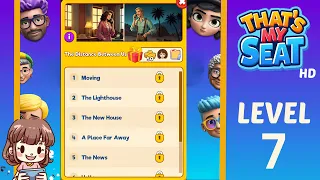
The Distance Between Us Level 7 Pattern Overview
The Overall Puzzle Structure
At the start of Level 7 in "The Distance Between Us," players are presented with a familiar cafe scene, but with a slightly more crowded arrangement of tables and characters. The core mechanic remains the same: strategically seating characters at tables to fulfill their preferences and narrative cues. The challenge lies in managing the limited seating options and correctly interpreting the dialogue to determine who should sit where. The level is fundamentally testing the player's ability to quickly analyze character interactions and make optimal seating choices under a bit of time pressure, given the available spots.
The Key Elements at a Glance
- Characters: A diverse cast of patrons arrives throughout the level, each with potential seating preferences or being part of conversations.
- Tables: Several tables are available, some with single seats, others with multiple. The arrangement can be tight, creating a puzzle out of fitting everyone in.
- Dialogue Bubbles: These are crucial. They provide hints about who wants to sit where, who is talking to whom, and sometimes subtle clues about relationship dynamics or reactions.
- Seating Indicators: Footprints or visual cues might appear on the floor or at tables, indicating where a character is looking or intended to sit.
- Timer/Hearts: Although not always strictly visible on every screen, the implicit pressure of completing the level efficiently is present. Losing hearts (represented by the icons at the top) signifies incorrect choices or wasted time.
Step-by-Step Solution for The Distance Between Us Level 7
Opening: The Best First Move
The most effective opening move is to place James at the bar. He is the first character to speak, and his dialogue clearly indicates he's the bartender, making his placement at the bar the most logical and straightforward choice. This action immediately resolves one character's position and opens up the rest of the seating puzzle without creating immediate conflicts.
Mid-Game: How the Puzzle Opens Up
Following James's placement, the next critical step involves identifying characters with clear seating intentions. Gavin is introduced and his dialogue points him towards the bar area, specifically near James. Placing Gavin at a stool at the bar, across from James, seems the logical next step. This allows for their interaction to begin and clears up a potential seating conflict.
As more characters like Blake and Madona appear, the game presents opportunities for multiple pairings. Blake's dialogue indicates he's watching a match, and Madona is seated nearby. Placing Blake in a seat adjacent to Madona, likely at one of the tables, makes sense to facilitate their conversation about the match.
The introduction of characters like Kayli and Tristan requires careful attention to their dialogue. Kayli's strong statement about watching quietly suggests she wants a seat where she can observe without interruption. Tristan's mention of "the price of everything" hints at a possible interest in the menu or a desire for a quieter spot. Placing them at separate tables, perhaps with Tristan closer to the bar and Kayli at a more isolated table, can be a good strategy.
End-Game: Final Cleanup and Completion
The end-game often involves resolving the seating arrangements for characters like Dasha, Ursa, and others who might have more complex interactions or who arrive later. Dasha's observation about a girl with headphones (Emel) suggests she might be interested in Emel's situation. Placing Dasha at a table where she can observe Emel, possibly across the cafe, would be a good move.
Ursa's complaint about a chair and wanting the table cleaned properly indicates a need for a specific type of seating or an interaction with a server. Placing Ursa at a table that can be cleared or serviced, perhaps one with a clear line of sight to the service area, is key. The final characters, such as Neva and Birgit, will often have dialogue that either solidifies existing pairings or creates new ones. For example, if Neva and Tristan are drinking together, seating them at the same table would be logical. Birgit's statement about living and coffee implies a reflective mood, so perhaps a quieter corner table would be suitable. The final sequence involves ensuring all characters are seated in a way that logically follows their dialogue and interactions, completing the puzzle.
Why The Distance Between Us Level 7 Feels So Tricky
Misinterpreting "The Match" Scene
Players might misread the significance of "watching the match." The visual cues might show multiple characters interested in the television or screens, leading to an assumption that they all want to sit together. However, the dialogue reveals that only specific characters are actively discussing or commenting on the match. The trick is to not just look at who could see the match, but who is actively engaged with it through their dialogue. For example, Blake's dialogue about sitting "side by side with Madona" is the definitive clue, not just the fact that they might both be facing the same direction.
The Overcrowding Paradox
The cafe setting can become quite crowded in this level, leading players to feel overwhelmed by the sheer number of characters and tables. This often causes players to panic and make hasty seating decisions. The visual detail that solves this is often a character's specific dialogue that places them directly next to or across from another character. For instance, when Ursa is talking to Heinz, the visual cue will be Ursa's gaze or a specific footprint leading to Heinz's seat. The trick is to isolate these direct interactions and prioritize them before trying to fit in others who have more general statements.
The Bartender's Role and Its Implications
James, the bartender, is a fixed point of interaction. His dialogue often serves as a catalyst for other characters' decisions. Players might overlook the implications of placing other characters at the bar, potentially blocking James or creating awkward conversations. The visual detail to look for is the direct address or interaction James has with other characters. For example, his conversation with Gavin about the bar stool is a clear indicator that Gavin should be seated there. The mistake is often in seating someone at the bar who doesn't have a direct interaction with James, thus wasting a valuable bar seat.
Dialogue Nuances and Unspoken Preferences
Some characters have dialogue that hints at preferences without explicitly stating them. For example, someone complaining about the "price" might prefer a table away from the main hustle, or someone talking about "hard work" might be observing others. The trick is to listen for these subtle cues. Players often make the mistake of seating characters based only on who they are talking to at that moment, rather than inferring broader personality traits or potential preferences. The visual detail that helps is observing the character's overall demeanor and the context of their dialogue. For instance, if a character is lamenting their financial situation, they might be less inclined to occupy a prime table.
The Logic Behind This The Distance Between Us Level 7 Solution
From the Biggest Clue to the Smallest Detail
The core logic for solving this level, and many similar social simulation or seating puzzles, is to prioritize direct, explicit instructions or interactions. Start with the most obvious placements: the bartender at the bar, characters explicitly stating they want to sit next to or across from someone. Once these "big clues" are resolved, move on to the more subtle interactions. These might include characters observing each other, commenting on specific events (like a match), or expressing a mood that suggests a particular type of seating (e.g., quiet vs. lively). Finally, address any characters whose dialogue is more general or who arrive later, fitting them into the remaining available spots while ensuring they don't disrupt established pairings.
The Reusable Rule for Similar Levels
The reusable rule for levels like this is: Prioritize direct connections, then indirect connections, then contextual preferences.
- Direct Connections: Characters who explicitly state their desire to sit with or near another specific character (e.g., "I want to sit next to you," "Let's sit together").
- Indirect Connections: Characters who are involved in a conversation or reaction involving another specific character (e.g., commenting on their actions, responding to something they said).
- Contextual Preferences: Characters whose dialogue reveals a mood, a situation, or a general observation that suggests a seating preference (e.g., "I need some quiet," "This is too expensive," "I'm here to watch the game"). By following this hierarchy, players can systematically resolve the seating arrangements, minimizing conflicts and ensuring optimal placement for everyone.
FAQ
How do I know who to seat first in "The Distance Between Us" Level 7?
Start with characters whose dialogue clearly defines their role or immediate intention, like James at the bar or someone explicitly asking to sit with another character.
What if multiple characters want the same seat?
Carefully re-read the dialogue. The character whose statement is more direct or time-sensitive usually takes precedence. If two characters have equally strong claims, consider who they are interacting with.
How do I deal with the crowded tables in this level?
Focus on the direct interactions first. Once those characters are seated, the remaining spaces will become clearer. Don't get overwhelmed by the total number of seats; focus on solving one interaction at a time.