
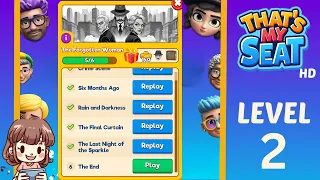
The Forgotten Woman Level 2 Pattern Overview
The Overall Puzzle Structure
At the start of Level 2 in "The Forgotten Woman," players are presented with a scene depicting a bar, reminiscent of a crime scene investigation. The screen shows several characters, each occupying a specific seat at the bar or nearby. The primary mechanic involves identifying the correct character based on the narrative clues provided. The puzzle is fundamentally testing the player's ability to connect descriptive text with visual representations of characters, focusing on their appearance, actions, or dialogue as presented in the game. The challenge lies in accurately associating each description with the correct individual among the available options.
The Key Elements at a Glance
- The Bar Scene: This is the central visual of the level, featuring multiple bar stools and characters. The environment itself sets the stage for a mystery or investigation.
- Character Portraits: Each character involved in the story is represented by a distinct portrait at the bottom of the screen. These portraits are the primary interaction points for solving the puzzle.
- Narrative Clues: Text descriptions are presented, detailing events or character traits. These clues are crucial for identifying the correct characters and their positions.
- The Goal: The objective is to correctly match each narrative clue to the corresponding character portrait, progressing the story and solving the mystery.
Step-by-Step Solution for The Forgotten Woman Level 2
Opening: The Best First Move
The most effective first move in this level is to correctly identify "Mark." The clue, "On my left was Solozio. Hey, Mark, for thirty years under the Borgias, Italy had war… yet they produced Da Vinci and Michelangelo. Switzerland had five hundred years of peace… and the only thing they made was the cuckoo clock," strongly suggests Mark is the character who made these observational, almost philosophical statements. Clicking on the portrait labeled "Mark" and placing him in a relevant spot (in this case, a stool at the bar) is the initial logical step. This move helps to establish a known element, simplifying the subsequent identifications.
Mid-Game: How the Puzzle Opens Up
Following the identification of Mark, the next critical step is to identify "Dix." The clue states, "Dix was handing over the bar’s routine payoff to the cop behind the counter. It was the only reason the place stayed alive. Money isn't dirty - just people. I don't remember much else from that day." This description directly links Dix to a transaction with a "cop behind the counter." Observing the characters, Silas is depicted wearing a police uniform. Therefore, placing Dix on a stool next to Silas is the logical progression. This action helps to narrow down the remaining possibilities and connect the narrative to the visual elements. The game then presents more clues, like the one about "Vernon," who was described as a "man drowning in debt" and was sitting alone at the table. Matching Vernon to his portrait and placing him correctly opens up more of the puzzle.
End-Game: Final Cleanup and Completion
As the mid-game progresses, the remaining characters need to be identified and placed. The clue about "Noah" as the "unhappiest man in the world" and his story about selling a saxophone to pay off debt leads to Noah's portrait. Similarly, the description of "Floyd" catching his wife with his business partner and him just drinking identifies Floyd. Finally, "Duke," who invited his wife to salvage their marriage and left flowers, is the last character. The game then presents the final scene where all characters are correctly placed. The "Well Done!" screen confirms the successful completion of the level. The sequence often involves identifying characters through their distinctive actions or descriptions, and then correctly placing them in the scene based on relative positions mentioned in the clues.
Why The Forgotten Woman Level 2 Feels So Tricky
Misinterpreting Relative Positions
A common pitfall in this level is misinterpreting relative positioning clues, such as "on my left" or "next to." Players might overlook subtle cues in the scene or misinterpret which character is speaking. For instance, the clue "On my left was Solozio" relies on correctly identifying who "on my left" refers to. If the player incorrectly identifies the speaker or the reference point, their entire arrangement can become skewed. The key to solving this is to look for characters who are directly interacting or whose positions are explicitly stated relative to another correctly identified character. The visual cues of characters being placed at the bar or at a table are important context.
Overlooking Character Details
Sometimes, the narrative clues might be quite descriptive, but players might overlook subtle details in the character portraits that could help with identification. For example, when identifying Floyd, the clue mentions he was "just drinking." While other characters might also be associated with drinks, Floyd's portrait might subtly indicate a more somber or resigned demeanor, aligning with the "just drinking" aspect. Similarly, Noah's description as the "unhappiest man" could be reflected in his facial expression or posture. Paying close attention to these visual nuances alongside the textual descriptions is crucial.
Sequencing Errors
The puzzle is designed to be solved sequentially, with each correct placement opening up new possibilities or clarifying existing clues. A mistake in the early steps, such as misplacing Mark or Dix, can cascade into errors for subsequent character placements. This is because the clues often build upon previously established positions. If a player incorrectly places one character, the relative position clues for others will lead them astray. The best approach is to confirm each placement carefully, using the most definitive clues first, and then working through the less certain ones.
The Logic Behind This The Forgotten Woman Level 2 Solution
From the Biggest Clue to the Smallest Detail
The core logic for solving this level, and many like it, is a process of elimination and deduction, starting with the most concrete clues. The game provides a set of narrative descriptions, each pointing to a specific character. The strategy is to first identify characters with the most distinctive or unambiguous clues. For instance, the character in the police uniform (Silas) is a strong anchor. Once Silas is identified, any clues that refer to him or his position can be used to place other characters accurately. The game also provides clues that mention specific actions (payoff, drinking, inviting) or states of being (unhappiest, drowning in debt), which can be matched to the visual representations. By systematically matching these descriptive elements to the character portraits, players can gradually piece together the entire scene.
The Reusable Rule for Similar Levels
The universal rule for solving such character-matching puzzles is to prioritize definitive clues first and then use relative positioning to fill in the gaps. Start with clues that offer unique identifiers (like a uniform, a specific object associated with them, or a very distinct action) or unambiguous positional information. Once a few characters are placed correctly, their positions become reference points for other clues. For example, if "Mark is to the left of Solozio," and you've already correctly placed Solozio, you know Mark's approximate location. This iterative process, moving from the most certain to the less certain, is key to efficiently and accurately solving these types of narrative-driven puzzle levels.
FAQ
How do I identify Mark in The Forgotten Woman Level 2?
Look for the clue that mentions both "Solozio" and a comparison of Italian and Swiss history. The character fitting this description, typically associated with insightful commentary, is Mark.
What is the trickiest part of placing characters in this level?
The trickiest part is correctly interpreting relative positions like "on my left" or "next to." Ensure you've correctly identified the speaker and the reference character before placing others based on these clues.
How can I solve the puzzle if I get stuck on a character's placement?
If you're stuck, re-read all the clues and check your previously placed characters. Sometimes, a clue that seemed less important initially might become clear once other characters are in their correct spots. Also, look for subtle visual cues in the character portraits that match the descriptions.