
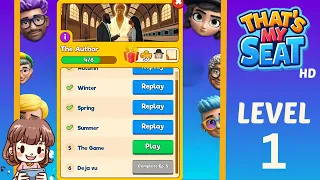
The Author Level 6 Pattern Overview
The Overall Puzzle Structure
At the start of "The Author" level 6, players are presented with a scene depicting a train station platform. Several characters are visible, each associated with a dashed outline indicating where they should be placed. The core mechanic involves matching characters to their designated spots, essentially solving a seating arrangement puzzle. The level tests the player's ability to observe subtle details within character descriptions and match them to the correct visual cues on the board, requiring careful reading and spatial reasoning.
The Key Elements at a Glance
- Characters: Various individuals with distinct appearances and names (e.g., Shinju, Calla, Ingram, Virgil, Birgit, Ebrar, Abene, Ishkur, Nyx, Shal-Im, Boreh, Alita, Andrew, Zehra, Durand). Each has a specific placement dictated by their description.
- Placement Zones: Dashed outlines on the benches and floor indicate where each character belongs. These zones are crucial for solving the puzzle, as they visually represent the target locations.
- Descriptive Text: A scrollable text box at the bottom of the screen provides descriptions and dialogue for each character. This text contains the vital clues needed to correctly place everyone.
- Progression Indicators: Hearts at the top left signify remaining lives, and the progress bar above the character portraits indicates how close the player is to completing the level.
- Boosters/Hints: A lightbulb icon suggests the availability of hints to assist in solving difficult matches.
Step-by-Step Solution for The Author Level 6
Opening: The Best First Move
The most effective initial move is to place Shinju. The text mentions her feeling uneasy "under the gaze of the orange bag." Observing the available items, an orange bag is prominently displayed near one of the seating areas. Placing Shinju in this area, which is clearly designated for her, sets a solid foundation and helps to unlock the descriptions of characters who interact with her or her surroundings.
Mid-Game: How the Puzzle Opens Up
Once Shinju is placed, the puzzle gradually reveals more connections. For example, "Virgil was a writer" and his character "was now standing right in front of him." This suggests Virgil should be placed in a position where he is visually facing Shinju, or in a corresponding designated spot. As more characters are placed correctly, their dialogue or descriptions provide further clues. For instance, "Ebrar was about to board the train. To prevent the fruits in her basket from getting damaged, she was carefully wrapping them one by one in newspaper." This hints at placing Ebrar near an area where she might be preparing to board, and also implies the presence of "fruits" or an item related to them. The key is to continuously scan the text for character-specific actions or relationships and cross-reference them with the visual cues and available character slots.
End-Game: Final Cleanup and Completion
As the puzzle progresses, the remaining characters often have more complex relationships or require finer attention to detail. For example, "Andrew had once felt the same excitement this young woman beside him was feeling. But that day, the person he was waiting for never stepped off the train." This implies Andrew should be placed next to the "young woman" mentioned (Zeha), and their interaction should reflect a past connection or a missed encounter. The final characters fill the remaining spots, often with dialogue that confirms their placement based on their interactions with those already seated. The completion is marked by all characters being in their correct spots, triggering a "Well Done!" screen.
Why The Author Level 6 Feels So Tricky
Misinterpreting "Gaze" and "Standing in Front of"
Players might misread "Virgil was a writer. And the character he had created for his novel—down to the exact appearance—was now standing right in front of him" as simply needing to place Virgil anywhere near Shinju. The trick lies in the detail: the "exact appearance" and "standing right in front of him." This implies a direct line of sight or a very specific adjacency. The visual clue here is the dashed outline directly in front of Shinju's designated spot. Placing Virgil there, rather than just nearby, is the correct interpretation.
The "Fruits in Her Basket" Misdirection
The clue for Ebrar, "To prevent the fruits in her basket from getting damaged, she was carefully wrapping them one by one in newspaper," can be misleading. Players might look for actual fruit objects on the board. However, the crucial detail is "wrapping them one by one in newspaper." This suggests Ebrar should be placed in a location where she can perform this action. The visual clue is often an empty space with a newspaper nearby, or a character with a newspaper as part of their initial setup, indicating a context where Ebrar's action makes sense. The "fruits" are implied rather than literal objects to be collected.
The "Waiting For Someone" Ambiguity
The description for Andrew, "Andrew had once felt the same excitement this young woman beside him was feeling. But that day, the person he was waiting for never stepped off the train," is tricky. Players might focus on the "waiting" aspect and look for signs of a train. The key is "this young woman beside him," referring to Zehra. The placement requires Andrew to be directly adjacent to Zehra, and their dialogue suggests a shared past experience or anticipation, not necessarily a literal train event. The visual cue is their close proximity in their designated spots.
The Logic Behind This The Author Level 6 Solution
From the Biggest Clue to the Smallest Detail
The fundamental logic of this level, and many in "That's My Seat," is to start with the most explicit clues and then use them to deduce the placements of characters with more ambiguous descriptions. The "biggest clues" are usually those that directly reference an object on the board (like the orange bag for Shinju) or a very clear adjacency (like Andrew to Zehra). Once these characters are placed, their presence on the board and their dialogue become the "biggest clues" for the next set of characters. For example, if Shinju is placed, and another character's text refers to interacting with "the writer next to the worried girl," the player can then deduce Virgil's placement relative to Shinju. It's a process of elimination and deductive reasoning, using each correctly placed character to unlock the next piece of the puzzle.
The Reusable Rule for Similar Levels
The core solving pattern for levels like "The Author" Level 6 is to prioritize direct object references and clear spatial relationships mentioned in the character descriptions. Always look for:
- Named Objects: If a character's description mentions a specific item visible on the board (e.g., a bag, a newspaper, a book), try to place them near that item.
- Direct Adjacency: Phrases like "beside him," "next to her," "in front of," or "between" are strong indicators of required placements.
- Character Interactions: If a character's dialogue refers to another character by name or a defining characteristic (e.g., "the writer," "the girl with the red hair"), use this to link them.
- Process of Elimination: As more characters are placed correctly, the remaining options become more limited, making it easier to solve the more obscure clues.
By following this hierarchy—object first, then adjacency, then interaction, and finally elimination—players can systematically unravel the puzzle, even when descriptions are less straightforward.
FAQ
Why is it hard to place Shinju correctly in The Author Level 6?
Shinju's placement is tricky because her description uses the phrase "under the gaze of the orange bag," which could be misinterpreted as a need to interact with the bag rather than simply being near it in her designated spot. The key is to observe her character portrait and the closest orange bag, then match her to the corresponding spot.
How do I figure out where to put Andrew and Zehra in this level?
The description for Andrew mentions "this young woman beside him," referring to Zehra. The solution involves placing Andrew directly next to Zehra in their designated spots. The difficulty lies in deciphering that "this young woman" is Zehra, and that their description implies close physical proximity.
What's the trick with the "fruits in Ebrar's basket" clue?
The clue about Ebrar's fruits is a misdirection. Players might look for actual fruit items. However, the critical detail is her action: "wrapping them one by one in newspaper." This indicates Ebrar should be placed in a spot where this action is logical, often near a newspaper or in a preparation area, rather than needing to find fruit on the board.