
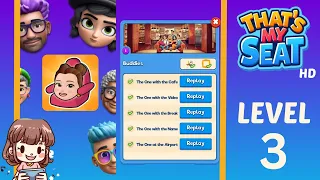
Buddies Level 3 Pattern Overview
The Overall Puzzle Structure
At the start of Buddies Level 3, players are presented with a scene reminiscent of a living room, complete with a couch, armchairs, a coffee table, and a foosball table. The objective is to identify and match characters to their correct dialogue or actions, which are presented in a checklist format at the bottom of the screen. Each character is represented by a portrait, and the player needs to drag these portraits onto the correct dialogue bubbles or scene elements. The puzzle is fundamentally testing the player's ability to observe visual cues, read dialogue, and make logical connections between characters and their stated motivations or actions. The layout is somewhat scattered, with characters appearing in different areas of the room, requiring careful observation to pinpoint their exact location and context.
The Key Elements at a Glance
- Character Portraits: These are the primary interactive elements. Each character (Russ, Hekles, Duck, Regina, Ranel, Jory, Jannie, Marsel, Chick) has a distinct portrait that needs to be matched to their corresponding dialogue or action.
- Dialogue Bubbles/Checklist: This is where the player's objective lies. Each item on the checklist describes a character's action or line of dialogue, and the goal is to place the correct character portrait onto the matching item.
- Scene Elements: The living room setting, including the couch, armchairs, coffee table, and foosball table, provides context for the characters' interactions. Some dialogue or actions are directly related to these objects (e.g., sitting on the couch, playing foosball).
- Footprints: These are crucial visual indicators. They show where characters have recently been or where they are supposed to be, guiding the player to place the correct character portrait in relation to the scene or other characters.
- Hearts/Lives: These represent the player's remaining attempts or health. Making incorrect matches can deplete these, so accuracy is important.
Step-by-Step Solution for Buddies Level 3
Opening: The Best First Move
The most effective opening move is to focus on the dialogue concerning Russ and his breakup with Ranel, as described in the first checklist item. The video shows Russ is near the couch, and Ranel is further away, near an armchair. The dialogue is "Russ is explaining his breakup with Ranel to his sister Monika, desperately trying to pull the classic 'We were on a break!' defense." Observing Russ near the couch and spotting the footprints leading towards him allows the player to drag Russ's portrait to this dialogue. This is a strong start because Russ is a central figure in this statement, and his location is relatively clear. It also helps establish the dynamic between Russ and Ranel, even though Monika isn't immediately relevant to this specific match.
Mid-Game: How the Puzzle Opens Up
After correctly placing Russ, the puzzle begins to unfold by focusing on other characters and their actions. The next key move often involves matching Jory. The video shows Jory standing near the foosball table. The dialogue "All Jory can say in French is 'Bleu de la bleu, de la blu blu bleu,' while clearly eavesdropping on the breakup drama behind him" directs the player to drag Jory’s portrait onto this statement. This is a good mid-game move because Jory's dialogue is distinct and his location near the foosball table is evident.
Following this, the clue about the doorman, Hekles, becomes apparent. The video shows Hekles near the kitchen area. The dialogue is "The doorman, Hekles, came to fix the bathroom door but nearly had a heart attack when a monkey popped out from behind a plant." Dragging Hekles to this statement is the logical next step. This move is facilitated by seeing Hekles’s position relative to the kitchen and the description of his actions.
As more characters are placed, the scene becomes clearer. For example, Regina is seen attempting to teach Jory something, which aligns with the dialogue "Regina is attempting to teach Jory French, but honestly, it's like teaching a goldfish to tap dance." Placing Regina on this clue is straightforward once her position and the relevant dialogue are identified.
Similarly, Ranel's interaction with the duck leads to the clue: "Ranel is dealing with the breakup by flipping through a fashion magazine and venting to the duck next to her, explaining why 'we were on a break' doesn't mean 'go cheat.'" Matching Ranel to this, especially as she is seen near an armchair with a magazine and the duck is also in proximity, solidifies this connection.
The gameplay then progresses to matching Jannie with her reaction. She is located near the foosball table and her dialogue is "Jannie freezes, then screams, 'Oh my Gosshh!' loud enough to scare the neighbors." This is a recognizable moment where her reaction is quite pronounced.
Finally, the mischievous Marsel (the monkey) is seen popping out from behind a plant, aligning with the clue about Hekles's near heart attack. This is a visually striking moment that confirms Marsel's placement. The chicken also plays a role with its action: "The chicken climbed onto a suspicious household object and freaked out when a loud noise spooked it." Observing the chicken's movement and its interaction with an object in the room is key to solving this.
End-Game: Final Cleanup and Completion
The end-game involves placing the remaining characters and ensuring all dialogue is correctly matched. Once the major interactions are resolved, the focus shifts to the characters whose actions might be less obvious or whose dialogue is more subtle. For instance, the final checklist item often requires placing Russ again or confirming his role in a statement. The gameplay might show Russ interacting with Monika or another character to finalize a clue. The key is to systematically go through the remaining checklist items, using the character portraits that haven't been placed yet and cross-referencing them with their described actions or dialogue. The footprints and the positions of other characters often provide the final hints needed.
The level concludes when all character portraits are correctly placed on their corresponding dialogue or action items. A "Well Done!" screen appears, indicating successful completion of the level, often accompanied by rewards and a summary of the character pairings.
Why Buddies Level 3 Feels So Tricky
Misinterpreting the "Break" Dialogue
Why players misread it: Many players might initially struggle with the dialogue related to the breakup, particularly the phrase "we were on a break." This line is famously associated with the TV show Friends, and players might get caught up trying to match it to a specific scene or character from that show, overlooking the game's own context. They might also incorrectly assume that all characters involved in a breakup conversation should be placed on the same clue. What visual detail solves it: The solution lies in carefully observing the character portraits and their positions. The video shows Russ is physically near the couch and actively speaking, making him the primary candidate for the dialogue about his breakup. Ranel is also involved but is presented separately, leading to a different clue. The key is to match the dialogue to the character actively performing the action or speaking the line, not just anyone involved in the situation. How to avoid the mistake: Pay close attention to which character is physically closest to the item being described and which character's portrait is most prominently featured in relation to the action. Don't assume a shared situation means a single placement for multiple characters.
The Scattered Nature of Clues
Why players misread it: The characters and their associated actions are spread across the entire living room scene. This can make it difficult to quickly scan and identify the correct pairings. Players might see a character and then struggle to find the matching dialogue, or vice versa, leading to frustration. They might also overlook smaller details like footprints or character expressions. What visual detail solves it: The footprints are the most crucial visual cue here. They clearly indicate where characters are or have been, and where they should be placed. For instance, seeing footprints leading from the kitchen towards Hekles helps confirm his role as the doorman who fixed the door. Similarly, footprints around the foosball table help identify Jory and Chazler. How to avoid the mistake: Make it a habit to scan the entire screen for footprints as soon as a character or dialogue item is identified. These visual markers are the game's way of providing direct hints. Also, take a moment to identify all available characters before attempting to place them.
The Monkey Business and the Chicken's Fright
Why players misread it: The character Marsel (the monkey) and the Chick (the chicken) can be tricky because their actions are more dynamic and potentially less obvious than the human characters. The monkey popping out from behind a plant might be missed if the player isn't paying close attention to the background elements. Similarly, the chicken's fright might be subtle. What visual detail solves it: The dialogue itself is the primary solver. The line about the doorman nearly having a heart attack "when a monkey popped out from behind a plant" directly points to Marsel and his hiding spot. For the chicken, the description of it being "spooked" by a "loud noise" and climbing onto a "suspicious household object" is the key. Observing the chicken's animated reaction and its proximity to certain objects helps pinpoint this. How to avoid the mistake: Don't dismiss the animal characters as mere decorations. Their actions are directly tied to specific dialogue. When in doubt, read the dialogue carefully and then actively search the scene for the described action. Look for animated characters or unusual behaviors.
The Logic Behind This Buddies Level 3 Solution
From the Biggest Clue to the Smallest Detail
The core logic of solving Buddies Level 3, and indeed most levels in this chapter, revolves around a process of elimination and careful observation of environmental cues. It starts with identifying the most obvious clues – usually dialogue that directly names a character or describes a very specific, unique action. For example, Russ's explanation of his breakup is a clear starting point because it names him and describes his typical defense.
Once a character is placed correctly, this information helps narrow down the possibilities for other characters and their dialogue. The placement of Russ might inform the player about Ranel's situation, or the context of the breakup. The presence of footprints is a crucial environmental detail that acts as a visual anchor. They tell you where characters are positioned or where they are supposed to go.
The game then guides you by presenting dialogue that matches the visual cues. If you see Hekles near the kitchen, and there's a clue about a doorman fixing something, that's a strong connection. The trick is to systematically match these concrete links. For the more abstract or dynamic clues (like the monkey or the chicken), you rely on the dialogue being very specific about the action and then finding the character performing that exact action. It's about translating the written word into a visual search within the game scene.
The Reusable Rule for Similar Levels
The fundamental rule for solving these "That's My Seat" levels, and particularly Buddies Level 3, is to always prioritize visual evidence (character positions, footprints, object interactions) and match it directly to the most specific dialogue available.
Here's a breakdown of the reusable rule:
- Identify Characters and Dialogue: First, get a clear overview of all available character portraits and all the dialogue items in the checklist.
- Seek Direct Matches: Look for dialogue that explicitly names a character or describes a unique, easily identifiable action associated with them. Place these characters first.
- Utilize Environmental Cues: Pay extremely close attention to footprints, character proximity to objects (couch, foosball table, plants), and character animations. These are direct hints. For example, if dialogue mentions someone at the foosball table, look for characters near it.
- Process of Elimination: As you place characters, cross them off the available list and the dialogue list. This helps simplify the remaining choices.
- Contextual Clues: If a character is involved in multiple dialogues, consider which dialogue best fits their immediate surroundings or actions. For instance, if a character is near the kitchen, they are more likely associated with a dialogue mentioning kitchen-related actions.
- Don't Overthink: Avoid getting bogged down in story references or complex interpretations. The game provides direct visual and textual clues for a reason. Stick to what you can directly observe and read.
This methodical approach, starting with the most obvious connections and then using environmental cues and elimination to solve the rest, is the most efficient way to clear these puzzle levels quickly and accurately.
FAQ
Q1: Why can't I find where to place Russ for the breakup dialogue? A: Make sure you're looking at the correct dialogue related to Russ's breakup. Check his proximity to the couch and the footprints leading towards him. Sometimes, the simplest solution involves matching the character to the immediate scene, not just anyone involved in the conversation.
Q2: I see footprints, but I don't know which character they belong to. A: Footprints often correspond to characters who are actively involved in a scene or have just completed an action. Look for characters who are near the footprints or whose dialogue describes their movement or location. Try to match the footprint pattern or location to the character's potential path.
Q3: The dialogue mentions a monkey and a chicken. Where are they and what are they doing? A: Look for the animal characters within the scene. The monkey might be near plants, and the chicken might be reacting to something. Match their actions to the specific descriptions in the dialogue, such as the monkey popping out from behind a plant or the chicken being spooked.