
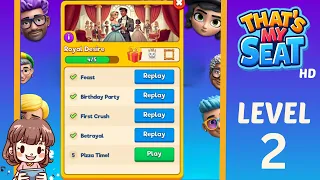
Royal Desire Level 2 Pattern Overview
The Overall Puzzle Structure
At the start of Level 2 in the "Royal Desire" story chapter, you're presented with a dining hall scene where various characters are milling about. The core of the puzzle involves seating these characters according to their relationships and preferences, which are described in the text boxes at the bottom of the screen. The board is essentially a seating arrangement, with specific spots designated for different guests. The major mechanics involve tapping on a character and then tapping on an available seat or another character to indicate a desired interaction or placement. The level is fundamentally testing your ability to correctly interpret social cues and relationships within a royal setting, translating them into a physical seating arrangement.
The Key Elements at a Glance
- Characters: A variety of royals and guests are present, each with unique names and depicted portraits. Their personalities and relationships are key to solving the puzzle.
- Seats: Designated spots around tables and in other areas of the ballroom. These are the "objects" you manipulate.
- Dialogue/Hints: The text boxes at the bottom provide crucial information about who likes whom, who is related to whom, and who dislikes certain things (like vegetarian meals).
- Interaction Icons: Some characters have icons above their heads (e.g., hearts, crowns) indicating their status or relationships, which can serve as visual clues.
- Goal: To correctly seat all characters based on the provided descriptions to progress.
Step-by-Step Solution for Royal Desire Level 2
Opening: The Best First Move
The best first move from the video is to identify the most rigidly defined relationships or seating requirements. In this case, that means focusing on characters who are explicitly stated to be together or separated. The initial placement of Duke and Ethan is a good starting point as their descriptions are quite specific about their proximity to others. For example, the hint "Mysterious and cold Ethan is at the front of the line, kissing the princess’s hand" immediately tells you Ethan's position relative to a specific person (implied to be the princess) and a location ("front of the line"). Similarly, placing King Henry and his wife is also a clear early step.
Mid-Game: How the Puzzle Opens Up
Once these key figures are placed, the puzzle begins to open up. You'll start seeing how the remaining characters' preferences connect to the already seated ones. For instance, if you've seated Ethan near the princess, you can then look for clues about who might be influencing Ethan or who Ethan is influencing. The video shows players using the hint about "Handsome Duke prepares to present his gift at the end of the congratulatory line." This means Duke needs to be placed in a position where he can logically interact with the "line." As characters are correctly placed, the descriptions at the bottom of the screen will often have their corresponding checkboxes ticked, confirming your progress and narrowing down the possibilities for the remaining guests.
End-Game: Final Cleanup and Completion
The final stages of the puzzle involve placing the characters with less defined or more nuanced relationships. This often means piecing together who is left and where they fit based on elimination and subtle clues. For example, if a character is described as being "close to the king," and the king is already seated, you would look for an available seat near him. The video demonstrates that once most characters are placed, the remaining ones can be fitted in by carefully reading the last few descriptions and observing available seats. The final check often involves ensuring all indicated relationships are satisfied and that no conflicting statements are being made by the character placements.
Why Royal Desire Level 2 Feels So Tricky
The Misleading "Line"
Players often misread the concept of a "line." At first glance, it might seem like a literal queue. However, in this context, it refers more to a social pecking order or a sequence of introductions at a royal event. The visual cue that solves this is observing the character portraits and how they are grouped. Instead of a single file line, think of it as a set of desirable positions or interactions. For example, "at the end of the line" might mean furthest from the main seating area or closest to a specific point of interest, not necessarily the back of a physical queue.
Subtle Relationship Clues
The descriptions can be subtle. For instance, a statement like "Kate is the cousin who envies the princess. She spreads untrue rumors about her, as long as Ethan hears them" has multiple layers. The envy is the primary clue for Kate's potential placement (perhaps not directly adjacent to the princess but somewhere she can observe and spread rumors). The crucial part is "as long as Ethan hears them," which means Kate's placement is also dependent on Ethan's proximity. The visual detail here is spotting the specific individuals mentioned and seeing how their proximity affects the placement of others. Misinterpreting this can lead to placing Kate too far away or too close, failing to satisfy the condition.
The Vegetarian Dilemma
A common trap involves character preferences, like the vegetarian option. The hint "Samira is having a meal with the king's close friend. A life without meat is unthinkable for her" is a key example. It's not just about seating Samira; it's about ensuring her companion's meal is also appropriate. This requires looking at the food icons on the tables. If Samira is seated with someone who is implied to be vegetarian (or simply not wanting meat), you need to ensure her table has the vegetable dishes, not the meat. The visual cue is the presence or absence of the meat platter versus the salad bowls on the tables. A simple misplacement can lead to dissatisfaction if the food isn't right.
The Logic Behind This Royal Desire Level 2 Solution
From the Biggest Clue to the Smallest Detail
The universal logic for solving this level, and similar puzzle games, is to start with the most definitive pieces of information and then work your way down to the more nuanced ones. The "biggest clues" are usually explicit statements of relationship or location: "King Henry is dancing with his wife," "Ethan is at the front of the line," or "Bethy is the youngest." These provide anchor points. Once these are placed, you use the smaller details – like who needs to hear rumors, who prefers not to dance, or who has dietary restrictions – to refine the positions of the remaining characters. It's a process of deduction, using each correct placement to eliminate possibilities for others.
The Reusable Rule for Similar Levels
The reusable rule for similar levels in "That’s My Seat" and other relationship-based puzzle games is: Prioritize explicit statements, then deduce based on relational cues and visual context. Always look for the most direct instructions first (e.g., exact pairings, stated locations). Then, use secondary information (e.g., "envies," "hears rumors," "prefers") to position characters relative to those anchors. Finally, confirm with visual elements like food types or interaction icons. This systematic approach of moving from the obvious to the subtle ensures all conditions are met.
FAQ
How do I know where "the line" is in Royal Desire Level 2?
"The line" refers to social proximity or sequence of importance, not necessarily a physical queue. Look for characters described as being at the "front" or "end" of a "congratulatory line" and seat them in positions that logically reflect a royal progression or interaction, often near prominent figures.
What if a character has multiple conflicting hints?
In Royal Desire Level 2, hints are generally designed to be complementary rather than conflicting. If you encounter something that seems contradictory, re-read the descriptions carefully. Often, one hint might describe a character's internal preference, while another describes their action or interaction with someone else. Prioritize the action-based hints for placement.
How important are the food items on the tables?
The food items are crucial for levels involving dietary preferences or social interactions related to meals. If a character's description mentions a dislike or preference for certain foods (like meat or vegetarian options), ensure the table they are seated at has the correct food items displayed. This is a key visual cue for a correct placement.