
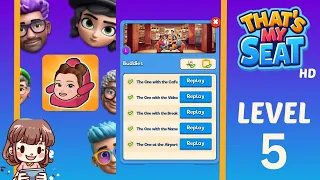
Buddies Level 1 Pattern Overview
The Overall Puzzle Structure
At the start of Buddies Level 1, you're presented with a scene that looks like a typical coffee shop gathering. Several characters are seated, and the goal is to match them with their correct dialogue or reactions. The board is laid out with character icons at the top and corresponding dialogue options at the bottom. The primary mechanic involves tapping on a character and then tapping on the dialogue that best fits their situation or personality. This level is fundamentally testing your ability to observe the characters' expressions and match them with the correct lines of dialogue, a core mechanic for the "Buddies" story chapter.
The Key Elements at a Glance
- Characters: The scene features a cast of characters, each with a distinct emoji-like avatar. You'll see characters like Aleph, Kyra, Honor, Briana, Esme, Russ, Ranel, Chazler, Jory, and others. Each character has a unique reaction or line of dialogue that needs to be matched correctly.
- Dialogue Options: Below the character scene, you'll find a list of dialogue options. These are presented as text bubbles, each associated with a character. Some dialogue is straightforward, while others might be a bit more nuanced, requiring you to understand the context of the scene.
- Hearts: These are your lives or attempts. Making incorrect matches can deplete your hearts, so accuracy is key.
- Gems/Coins: These are the in-game currency, used for hints or retries if you get stuck.
- Play Button: This initiates the current episode or scenario.
- The "Well Done!" Screen: Successfully completing the level leads to this screen, showing your progress and rewards.
Step-by-Step Solution for Buddies Level 1
Opening: The Best First Move
The most effective opening move in this level is to immediately identify the character who is clearly reacting to something specific. In the video, the first obvious interaction is with Russ. He's shown with heart eyes and is looking towards Ranel. This visual cue strongly suggests he has a crush on her. Therefore, the best first move is to tap on Russ and then select the dialogue option that reflects his infatuation, which is often something like, "Ranel bursts into the café..." and then choosing the line associated with his reaction to her. This immediately sets the stage and simplifies the subsequent choices by eliminating one character-dialogue pair.
Mid-Game: How the Puzzle Opens Up
After correctly matching Russ with his reaction, the puzzle becomes clearer. The next logical step is to look for other strong visual cues. For instance, Monika is shown finishing her coffee and then reacting with surprise and alarm to Ranel's dramatic entrance. You'll see her with a shocked expression. You would then tap on Monika and select the dialogue option that describes her reaction to Ranel's appearance, such as "Just as Monika finishes her coffee, she hears screaming..." This process of elimination and matching based on facial expressions and dialogue context is crucial. You continue this by observing each character's reaction and matching it to the corresponding dialogue option. For example, Jory might lean in and ask a question, prompting you to select the dialogue that reflects his curiosity or a specific question he's posing.
End-Game: Final Cleanup and Completion
As you progress, the dialogue options might become slightly more subtle, requiring careful reading. For example, Chazler might be shown looking smug or making a statement about money, which would lead you to select his dialogue. The game often introduces a "plot twist" or a character's internal thought, and your task is to correctly assign these to the characters. In the video, the final interactions involve correctly matching characters like Regina and Jory to their respective lines of dialogue, which might involve Regina waving her hands or Jory asking a question about a boyfriend. The key to the end-game is to meticulously review the remaining characters and dialogue options, ensuring each connection is logical and visually supported by the character's animation and expression. Once all characters are correctly matched, you'll see the "Well Done!" screen, indicating successful completion of the level.
Why Buddies Level 1 Feels So Tricky
Misinterpreting Emotional Cues
- Why players misread it: Sometimes, a character's expression might be ambiguous, or the dialogue could be interpreted in multiple ways. For example, a character might look slightly surprised, but the accompanying dialogue could be interpreted as shock, disbelief, or even feigned surprise. Players might hastily pick a dialogue based on a general emotion without considering the specific wording.
- What visual detail solves it: The key is to look at the specific dialogue and see how it aligns with the exact facial expression and any accompanying animation. For instance, if a character has wide eyes and an open mouth, the dialogue should reflect genuine shock, not just mild surprise. The subtle nuances in the emoji-like faces are important.
- How to avoid the mistake: Take a moment to read each dialogue option carefully and compare it to the character's animation. Don't rush the matching process. If unsure, look for other characters or dialogue options that are more obvious to confirm your choices through elimination.
The "Plot Twist" Trap
- Why players misread it: This level, and others in the "Buddies" chapter, often introduce dialogue that describes a character's internal thoughts or a sudden turn of events (a "plot twist"). Players might mistakenly attribute these internal monologues or plot developments to characters who are merely reacting to them, rather than embodying them.
- What visual detail solves it: The solution lies in distinguishing between external reactions and internal thoughts or actions. If a dialogue describes a character thinking something or planning something secretly, it should be matched with a character whose animation suggests introspection or a subtle, unexpressed emotion, rather than an overt reaction.
- How to avoid the mistake: Pay close attention to the wording. Phrases like "secretly planning," "thinking to themselves," or "realizes" indicate internal actions. Match these with characters who are not actively engaged in an external dialogue or reaction. Look for a character who is perhaps more still or has a more contemplative expression.
Overlooking Character Placement
- Why players misread it: The characters are positioned around a couch and table. Sometimes, a character might be looking in a general direction, and players might assume they are reacting to the person closest to them, even if the dialogue implies they are reacting to someone else or a general situation.
- What visual detail solves it: The dialogue often provides the specific context. If the dialogue mentions a character entering or speaking, the reaction should be attributed to the character who is demonstrably reacting to that specific event, regardless of their physical proximity. The character's gaze and animation are the best indicators.
- How to avoid the mistake: Prioritize the dialogue's context over simple proximity. If the dialogue describes someone reacting to an entrance, find the character who is visually reacting to that entrance (e.g., turning their head, gasping) rather than just the person closest to them.
The Logic Behind This Buddies Level 1 Solution
From the Biggest Clue to the Smallest Detail
The core logic for solving levels like Buddies Level 1 in "That's My Seat" is a process of elimination and careful observation. You start by identifying the most obvious matches – characters with strong, unambiguous reactions or dialogue that directly correlates with their actions. For example, Russ's heart-eyes are a very strong clue. Once you make these clear matches, you systematically work through the remaining characters and dialogue options. Each correct match eliminates a character and a dialogue, simplifying the puzzle. You then focus on the more subtle clues, such as a character's gaze direction, their posture, or nuanced facial expressions, to match them with the remaining dialogue. It's about building confidence by solving the easy parts first, which then makes the trickier bits easier to decipher due to the reduced number of options.
The Reusable Rule for Similar Levels
The fundamental rule for tackling similar story-based puzzle levels in "That's My Seat" is to always prioritize clear visual and textual evidence.
- Identify the Obvious: Always look for the strongest, most direct matches first. This could be a character with an exaggerated emotion (like Russ's heart-eyes) or dialogue that explicitly names a character and describes their action.
- Eliminate and Simplify: Make these obvious matches. Each correct pairing removes possibilities, making the remaining choices clearer.
- Context is Key: When dealing with more subtle reactions or dialogue, always consider the context provided by the dialogue itself. Does it describe an internal thought, an external reaction, a question, or a statement? Match this context to the character's visual cues and their position in the scene.
- Use Process of Elimination: If you're stuck on a few options, don't guess blindly. Use the remaining characters and dialogue to deduce the correct pairings. If character A cannot be matched with dialogue X, and dialogue Y must belong to character B, then the remaining dialogue Z is more likely to belong to character A. This methodical approach ensures accuracy and efficiency.
FAQ
How do I know which character to match with which line of dialogue?
Look for clear visual cues like facial expressions (e.g., heart eyes, surprised faces), character actions (e.g., gesturing, speaking), and their gaze direction. Then, match these observations with the corresponding dialogue options provided at the bottom of the screen. Start with the most obvious matches to simplify the puzzle.
What happens if I make a wrong match?
Making an incorrect match will typically cost you one of your "hearts" or attempts. If you run out of hearts, you might have to replay the level or use in-game currency (gems or coins) to continue.
Are there hints available if I get stuck on a level?
Yes, the game usually provides a hint system, often indicated by a lightbulb icon or similar. Using a hint will typically reveal the correct match for one of the characters, helping you progress.