
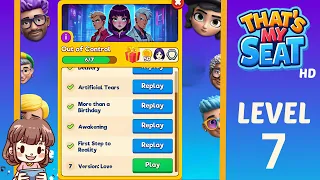
Out Of Control Level 7 Pattern Overview
The Overall Puzzle Structure
At the beginning of Out Of Control Level 7, you're presented with a dining scene where characters are seated at tables, each with a spoken dialogue and a corresponding avatar. The goal is to match the characters to their correct seating arrangements based on the dialogue. The scene is laid out like a seating chart, with multiple tables and various characters. The primary challenge of this level lies in carefully reading and interpreting the dialogue to correctly identify who should be seated where. It's a test of observation and deduction, requiring you to link spoken lines to the visual representation of the characters and their relationships or situations.
The Key Elements at a Glance
- Characters and Avatars: Each character has a distinct avatar and a line of dialogue associated with them. These are crucial for identifying their role and potential seating partner.
- Tables: The tables are where the characters are seated. The number of seats at each table and the existing occupants are key pieces of information.
- Dialogue: The text boxes provide the primary clues. You need to carefully read each line to understand the character's situation, their companions, or their desires.
- Checkmarks: Correctly placed characters will be marked with a green checkmark, indicating progress.
- Eraser and Hint Icons: These are game mechanics that can be used to correct mistakes or get help, though the goal is to solve it efficiently.
Step-by-Step Solution for Out Of Control Level 7
Opening: The Best First Move
The most effective starting move in this level is to correctly seat Ashley. The dialogue associated with Ashley clearly states she is ready for the night and sits at a table with two people, experiencing emotions from opposite ends of the spectrum. Observing the scene, we see a table with two empty seats. By placing Ashley there, you anchor a significant part of the puzzle and gain a clearer understanding of the remaining seating dynamics. This is a good starting point because Ashley's situation is quite specific and helps narrow down the possibilities for the other characters.
Mid-Game: How the Puzzle Opens Up
After seating Ashley, the next logical step is to focus on Lenny. Lenny's dialogue mentions shifting his chair to get a better view of the stage and implies that relationships need time to steep. Observing the scene, Lenny is shown near a table where a character named "Maki" is also present. Given the context of relationships and stage views, placing Lenny in a position to see the stage, likely at the same table as Maki, makes sense. This action will reveal another checkmark and further clarify the seating.
Following this, consider Seth. Seth's dialogue indicates he's eating meatballs and feels sad because he wanted to stay home and play video games. In the scene, Seth is depicted at a table with other characters. By matching Seth to his described situation, you can place him correctly, likely at a table where his mood or preferences align with the other characters. This continues the process of deductive reasoning, using the dialogue clues to fill in the seating chart.
Next, look at Kyra. Kyra wields her brush like an instrument and multitasks with ease, choosing colors while glancing at her work. This description suggests she's an artist or someone who is focused on her craft. In the game, you'll see a character in a similar artistic pose or with an item related to art. Matching Kyra to her description by placing her at an appropriate table is the next step.
Pay attention to Aurora, who is sitting at the same table with Freya and Valy. This dialogue directly links these three characters, making their placement straightforward. Find the table that currently has Freya and Valy and add Aurora to it. This is a crucial step as it confirms relationships and sets up further possibilities.
The next clue involves the statement "The truth is, everyone's going to hurt you." This statement is attributed to Borley, who is skipping from one song to the next. You need to find a character that matches this description, possibly indicating someone who is evasive or restless. Placing Borley correctly will help resolve the seating arrangement for the remaining individuals.
End-Game: Final Cleanup and Completion
As you progress through the level, you'll be left with a few characters to place. The final dialogues might be more subtle or dependent on the remaining seating options. For instance, the dialogue about "How do you define reality?" attributed to Motoko, who asked Kuze. You'll need to identify Motoko and Kuze in the scene and place them together at a table where their conversation makes sense. This might involve looking at their facial expressions or their proximity to other characters.
The level concludes by filling the remaining seats based on the final dialogue clues. You'll use the process of elimination and match the last few characters to their designated spots, completing the seating arrangement and clearing the level. The "Well Done!" screen confirms the successful completion.
Why Out Of Control Level 7 Feels So Tricky
Misinterpreting Dialogue: The Subtle Nuances
A common pitfall in this level is misinterpreting the nuances of the dialogue. For example, a character might mention a preference or a feeling that seems straightforward but could be interpreted in multiple ways depending on the context of other characters present. The key is to not just read the words but to understand the underlying sentiment or situation.
- Why players misread it: Players might focus too much on a single keyword or phrase without considering the entire context of the character's statement or how it relates to other characters at the table or in the scene. They might also overthink simpler clues, getting stuck on details that are less critical.
- What visual detail solves it: The solution is often found by looking at the character's avatar, their current seating, and how their statement relates to the available seats or other characters already placed. For instance, Ashley's "opposite ends of the spectrum" line is visually solved by her being seated with characters who appear to have contrasting emotions or personalities.
- How to avoid the mistake: Read each character's description fully and consider the other characters already seated. Look for visual cues in the character avatars that might reinforce their dialogue. For example, if a character is described as sad, their avatar might have a downcast expression.
The "Reality" Trap: Abstract Concepts
The dialogue involving "reality" and its definition can be particularly tricky. It's a more abstract concept that might lead players to search for literal interpretations rather than focusing on how it applies to the social interaction of the characters.
- Why players misread it: Players might get stuck trying to decipher a philosophical meaning of "reality" rather than understanding it as a conversational topic between characters. They might look for visual elements representing abstract concepts instead of focusing on who is speaking to whom.
- What visual detail solves it: The solution lies in who is speaking to whom. If Motoko asks Kuze about reality, they should be placed at the same table, likely in a conversation. The visual detail is the direct interaction implied by the dialogue.
- How to avoid the mistake: Treat the dialogue as a direct interaction between characters. If one character asks another a question, they are likely seated together. Don't get bogged down in the philosophical meaning of the words; focus on the social dynamic they represent.
The Subtle Social Cues: Reading Between the Lines
Some of the dialogues provide subtle social cues about relationships or feelings that aren't explicitly stated. For example, a character might be described as "pleased" or feeling a certain way about another character.
- Why players misread it: These cues can be missed if players are only looking for direct instructions. They might overlook the emotional subtext or the implied relationships, leading to incorrect placements.
- What visual detail solves it: The key is to observe the interactions. If a character is pleased with someone's date, they might be seated near that person, or their dialogue might express approval. The avatars, while stylized, can sometimes convey a sense of emotion that aligns with the dialogue.
- How to avoid the mistake: Pay attention to descriptive words about feelings or relationships. Look for how these descriptions might translate into seating arrangements. If a character is described as being pleased with another, ensure they are seated in a way that reflects this positive interaction.
The Logic Behind This Out Of Control Level 7 Solution
From the Biggest Clue to the Smallest Detail
The fundamental logic for solving this level, and many like it, is to start with the most direct and specific clues and then use those placements to deduce the positions of the remaining characters. The dialogue provides the "biggest clues" – explicit statements about who is with whom, or what their situation is. For example, "Aurora is sitting at the same table with Freya and Valy" is a direct clue that groups three characters. Once these larger groups or specific individuals are placed, you can then use the "smallest details" – more nuanced dialogue or visual cues – to fill in the remaining gaps. This methodical approach ensures that you build upon confirmed placements, reducing the chance of error.
The Reusable Rule for Similar Levels
The reusable rule for levels like this is simple: Prioritize direct information and build outwards.
- Identify Direct Links: Look for dialogue that explicitly connects two or more characters or describes a specific situation for a single character that can be visually identified (e.g., "sitting at a table with two people," "wields her brush").
- Place with Confidence: Seat these characters first. These are your anchors.
- Use Deductions: Once anchors are in place, use the remaining dialogue to deduce where other characters fit. If a character needs to be at a table with someone already placed, or if there's only one empty seat that fits a description, use that information.
- Observe Visuals: Always cross-reference the dialogue with the visual layout. The avatars and their arrangements provide confirmation.
- Iterate: Continue this process, using each correct placement to inform the next, until all characters are seated correctly.
This strategy works because it relies on objective information from the dialogue and visual layout, rather than subjective interpretation. By starting with the most concrete facts, you create a solid foundation for solving the more ambiguous parts of the puzzle.
FAQ
Who is sitting at the table with Freya and Valy in Level 7?
Aurora is sitting at the same table with Freya and Valy. This is a key piece of information to use for seating arrangements.
What is the trickiest part of Out Of Control Level 7?
The trickiest part is correctly interpreting the dialogue to match characters to their situations and companions, especially when the clues are more abstract or rely on subtle social cues.
How do I match characters to their seats in "That's My Seat" levels?
Start with the most direct dialogue clues that link characters or describe specific seating needs. Then, use deduction and visual cues from the character avatars and their current positions to fill in the remaining seats.